


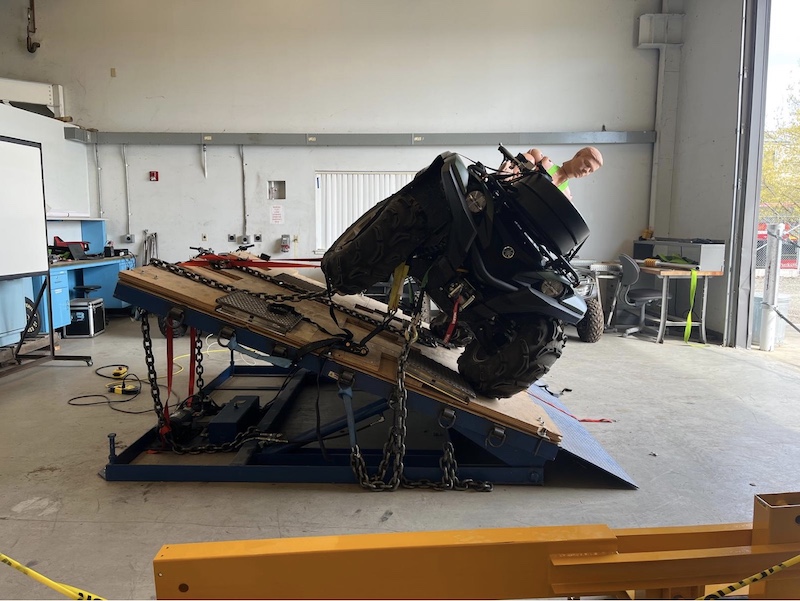
We developed an ATV safety test station for experimental evaluations of ATV stability and the performance of various roll bar designs on agricultural ATVs. CDC/NIOSH funded this project as part of the Western Center for Agricultural Safety and Health (WCAHS)’s five-year competitive renewal.
The study includes extensive infrastructure development, including a tilt table, autonomous ATVs, crash test terrain, crash tests, and extensive fieldwork to evaluate different models of ATVs and roll bars. The study includes four sections:

Static Stability
- Static stability is measured using wireless scales and digital inclinometers to determine ATV stability under different types, locations, and amounts of loads.
- This helps identify potential tipping points before an ATV becomes unstable.
Dynamic Stability
- Dynamic stability is measured using a sensing setup that includes IMU, and optical encoder under several tests, including J-turn, bump, and circular driving tests.
- This helps identify potential tipping points before an ATV becomes unstable.

Rollover Simulation (Experimental)
- Use real ATVs in controlled environments to test rollover risks under different conditions (e.g., speed, load, terrain).
- Helps in evaluating the effectiveness of protective devices and rider safety techniques.

Rollover Simulation (Computational)
- Used computer simulations to predict the rollover risk
- Helps in providing recommendations for safer operational conditions for agricultural ATV users
